Nov 19, 2010

Future of the Royal-Navy...growing concerns...

6 months ago that I wrote a 1st editorial on the future of the royal navy. By the October 19, the British government released its (infamous) 2010 Stategic Defense & Security Review (SDSR). I waited some more weeks (because the bad news arrives continuously) before +/- completing this editorial…

Picture credit: "Save the Royal-Navy.Org", more here

Carthography: (the only thing that can not be reduced…)
Coastline: 12 429 km (mainland coastline).
The UK EEZ is the eighth largest in the world, with a grand total (overseas territories included) of 6,805 million sq km (or 2,62 million sq mi)

Personnal Strenght:
+/- 39 100 regulars (+ 3600 volunteers; up to 19500 reserve).
Under the current 2010 SDSR, +/- 30 000 as expected by 2015 and ? likely +/- 27 000 by early 2020’s.

Aircraft-Carriers (THE TOMB OF THE ROYAL-NAVY ?)
Sunset of the Invincible class
As long expected, obviously, HMS Invincible, retired by mid-2005, will never sail again (he was progressively cannibalized by 2005/2009 to provide spare-parts for the two others active light carriers, and this despite the official British claims about a effective “extended-readiness”), and will be maybe ? soon scrapped around 2011/2013.

Finally the HMS Ark Royal will be retired immediately by November 2010/april 2011 (instead of 2014) and probably scrapped around 2013/2018.

HMS Illustrious ended definitively their light AIRCRAFTS-carrier career since 2009, but their final fate (in any case, end of hull-life reached by late 2010’s…) remain uncertain, because currently under a final refit at Rosyth shipyard (13 month, 40 £ million, ended by early 2011) to be usable (helico-carrier) until late 2015…but…under the current 2010 SDSR, a choice will be made between HMS Illustrious and the helico-carrier HMS Ocean to see which of the two is the better helicopter platform (only for the next 6/8 years, because in any case, both ships reached the end of their usefull life by 2018…).

But the final choice may be not easy...
If HMS Ocean is 16 years younger than the HMS Illustrious, has a stern vehicles ramp and already has the necessary equipment to carry helicopters, vehicles and troops = currently a far more better helico platform than the Illustrious… Unfortunately, the HMS Illustrious is nearly ended a last (costly) refit. British politicians may be tempted to finally choose the illustrious (story to avoid showing that the 40 £ million put into the Illustrious refit were not “wasted”…), and thus send the HMS Ocean in mothballed status (and likely to be scrapped or sold aboard by 2015/2018).

A “second-hand” sale of HMS Illustrious toward a foreign navy were very unlikely but a “second-hand” sale of HMS Ocean remain possible.

Up to 2 Queen Elizabeth (the white elephants ?)
The problem with these two ships is that their futures will be +/- sealed (in RN service) only in the next 2015/2016 SDSR. But various facts are already certain and various options are possible…

HMS Queen Elizabeth:
As expected since early 2010, the future of the HMS Queen Elizabeth will be finally (partially…) secured. Now “too expensive to cancel”, this ship was currently in advanced building process (blocks buildings, MT-30 turbines being delivered…). Now two majors options are possible…

- HMS Queen Elizabeth to be +/- nearly completed as expected (but without “sky-jump ramp”) as a very large helico carrier (with +/- 12 Merlin, 6 Apache & few others utility helico + troops), commissioned by 2016 (in fact a indirect HMS Ocean replacement…) and FULLY used by the RN (to be retired by 2046+) or ? rapidly mothballed when the HMS Prince of Wales enter service ?

- Or HMS Queen Elizabeth delayed by 2+ years and completed as a CATOBAR carriers with catapults (+ 500/800 £ million) by 2019+ and….used by Royal Navy (to be retired by 2050) or sold aboard ? (France/Brazil/India ?)

HMS Prince of Wales:
The HMS Prince of Wales will be finally built (a surprise for me, YES, I ADMIT)….but now with 1+ year of delays and additional cost (+/- 500/800 £ million per ship) to fit 2 catapults as a CATOBAR carrier and likely to carry F-35C or F/A-18 E/F, and sometime few French Rafales (in event of more deeply bilateral cooperation). Currently on very early building process (work starting on 1st engine). To be commissioned by 2020, with a probable +/- 40 years of service expected, to be retired around +/- 2060. In event of a Royal Navy service, it now become clear that this ship will normally operate just 1 squadron of 12 F-35C (she can carry up to 36…) and in any foreseeable future, no more than +/- 18 UK F-35C…

To be honest with you, for me, there's no doubt, the Royal Navy can no longer afford to have 2 large 60 000 tons carriers, each with 1500 sailors and 24/32 F-35C……

For the final destiny of these both ships (fully used by RN or mothballed or sold aboard), wait the next years (2011/2016) and the next “2015/2016” SDSR……amen !

Foreign sales of one or both vessels…a very hard task…


With the growing inability of the Royal Navy to use in the future these two large ships, persistent rumors appear on an opportunity to sell 1 carrier aboard: The only countries capable (FINANCIALLY SPEAKING) to buy one CVF are:

France:
The French Navy wants a second carrier, but the finances/internal policy continuously delayed the project. The final choice on the PA 02 will be made by 2011/2012. If the french cancel construction of PA02 (built in french shipyard), the could be use occasionally a british carriers (few Rafales onboard), or they might be tempted to buy one of the two CVF (but in this case, in compensation, the Royal Navy must imperatively ordered some newer fleet tanker at a french shipyard…)…wait & see…


Brazil:
The Brazilian Navy want to replace their ageing aircraft carrier (1960’s Sao Paulo, Former French Foch) by 1 or 2 newer carriers by 2018/2025. If the British negotiators/politicians manage to convince Brazilians, they could sale one CVF by 2014/2019….wait & see…

India:
The Indian Navy planned to acquire 3 carriers in the next 10 years. If the 44000 tons "Vikramaditya" (former Russian "Gorshkov") will be delivered in 2012, the 40 000 tons "Vikrant " (Indigenously built) will be delivered by 2014. The Indians are planning to receive by 2018/2020 a third but more larger/capable carrier (50000+ tons, catapults). This project may appear a major opportunity for some british to sell one CVF to the Indian Navy…
But this option is not very easy, because the Indians are ALREADY in the process of designing their OWN 50 000 tons carrier, and don’t forget that the cost of the Indian 40 000 tons indigenous Vikrant carrier, currently under construction in southern India, is expected to be a third of the cost of the 65,000 tons HMS Queen Elizabeth, while the future Indian 50/60 000 tons carrier (maybe to be named INS Vishaal ?), will cost less than half of its British equivalent…wait & see…


Russia:
Russian Navy wants to have 3-6 newer aircraft carriers by 2050. But the state of its shipyards could seriously slow down or stop this (very/too ambitious) project. The sale of a British CVF would be financially feasible but much more complex politically. This deal could be done only if Russia chooses to be radically more closer to NATO policy (a major shift in russia policy during this 21st century)…wait & see…


China:
China continued its OWN studies on aircraft carriers. It seems very doubtful/unlikely that it wants to buy a British carrier.

+/- 1 Helico-Carriers (between short/long term solution…)
1 (0?) Ocean 22 000 tons, 203 meters, hull derived from the Invincible light carrier. Built on civilian standard, commissioned by 1998, with +/- 20 years of service expected, in any case, to be retired by 2018. Very unlikely to be replaced by a newer LHD and maybe, at the best, replaced by the HMS Queen Elizabeth (at a LPH version).

Naval Airwing (you may be ready for the worst)
Now, the handful of last Harrier will be retired by april 2011.

With the astronomical cost of the F-35B (150+ $ million each), the British are now forced to abandon it in favor of a more conventional aircraft. If currently the final choice is not “definitively official”, it appears certain that the F-35C will ultimately chooses. At the best case, we are moving to around +/- 40/50 UK F-35C commissioned by 2020/2023 (to compare with initial +/- 138/150 F-35B commissioned by 2012+…). It is clear that this figure +/- condemns the HMS Queen Elizabeth (24/36 F-35 onboard one CVF) as a PURE aircrafts-carrier….


For cons, the hope of many RN fan’s for the opportunity to purchase 20/40 additional F-35C after (2018/2030) the actual financial crisis is clearly a dream (with a cost that will continue to grow…inflation, ect ....). In the best case, a small purchase/order ”batch” of 10/15 aircraft by 2025/2030 will be made to compensate F-35C “life-attrition” (aircraft accidents/crash, wear). These F-35C, which came into service by 2020/2023, will have a life of +/- 30 years and will be retired by +/- 2052. …But…

Obiously, this whole affair is linked to the future of the 2 CVF…. But more worrying, some concerns arise about the possibility that in the coming years (2011/2016), the RAF finally impose the F-35A, equivalent to condemn definitively the british naval aviation…WAIT & SEE…

Naval Helicopters (fewer and…fewer…)
Few Sea-King ASaC.7 (AEW) :
Now very ageing helico, to be replaced by 2018. Some rumors emerge about the possibilities to convert 8 (of the 28 expected to be modernized as a HM2 standard) Merlin as a AEW helico...

+/- 28 Future-Lynx (ASW/SAR) :
60 originally planned early 2000's, now 28 expected to be received by 2015/2018, to be retired during 2040’s.


+/- 28 EH-101 :
44 initially commissioned by 1997-2002, now 28 Merlin are scheduled to be updated to HM2 standard (= others used as spare-parts or reserve status ?). (Some rumors that 8 of the 28 HM2’s would be used as AEW helico (Sea-King Asac Mk7’s replacement…). With probable +/- 30 years of service, to be retired around 2027/2032.


Naval Aircrafts (any future, except ? for the UAV…)
:
The 9 Nimrod-MR4 (+2 test aircrafts) initially expected to be received around 2012/2014 were now finally cancelled. With a fantastic waste of money (3 £ billion), because the 1st aircraft were ready, 3 more were 90% complete !!! and the five others +/- 40% completed...

AAW Destroyers (6)
6 Daring
(Daring, Dauntless, Diamond, Dragon, Defender, Duncan), 7500 tons, 152 meters, highly effective AAW destroyers (to replace obsolete type 42 AAW destroyers) but suffered from serious delays, cost-overruns, initial troubles (AAW missiles) and severes critics (the famous “fitted for but not fitted with”……). Commissioned by 2010/2013, with probable 30+ years of service, to be retired by 2040/2043. These AAW destroyers will probably receive some “second-hands” CIWS Phalanx withdrawn from the retired Type 42 destroyers, but it becomes increasingly likely that these AAW DDG will never receive Harpoon or Tomahawk missiles…

Toward 0 type 42
(Liverpool, Manchester, York, Gloucester, Edinburgh), now obsolete 4000 tons AAW destroyers, all to be retired by 2013.

ASW Frigates (17 in 2010, 13 by 2012 and +/- 6/10 ? by early 2030…)
From 4 to 0 Type 22
The 4 ageing frigate of "type 22" (Cornwall, Cumberland, Campbelton, Chatham), effective ASW ships thought the 1990’s but now ageing, relatively expensive to operate (250 sailors per ship), will be retired soon by April 2011 !

13 Type 23
(Argyll, Lancaster, Iron Duke, Monmouth, Montrose, Westminster, Northumberland, Richmond, Somerset, Sutherland, Kent, Portland, St Albans). 4800+ tons, 133 meters. Very effective ASW ships but now progressively ageing. All to be retired by 2023-2036 and replaced by fewer Type 26 frigates. But the next 2015/2016 SDSR maybe could threaten some ships…

6 to 10 ? type 26 ?
These new class of 6000 tons frigate were currently under study. But it is already clear that the 13 frigates of the Type 23 will never be replaced at “one for one basis”. At the worst, only 6 type 26 should be built or at the best, 8-10 type 26 built, all by 2022/2036…wait & see…

Mine-Hunters/Patrols Boats (toward a single modular design by 2020’s ?)
+/- 8 Sandown
(Walney, Penzance, Pembroke, Grimsby, Bangor, Ramsey, Blyth, Shoreham). 484 tons, 52 meters, commissioned by 1992/2001, with probable +/- 30 years of service, to be retired around 2022/2030.

+/- 8 Hunt
(Ledbury, Cattistock, Brocklesby, Middleton, Chiddingfold, Atherstone, Hurworth, Quorn). 750 tons, 60 meters, commissioned by 1980/1989, with probable +/- 30 years of service, to be retired around 2010/2019.

In fact, it become clear that the current british mine-countermeasures fleet (+/- 15 units) were far too bigger under the current/futures british needs (likely around +/- 6/8 MCM SPECIALIZED). It is highly probable that some of these currents MCM will be used in future as a patrol boats.

3 Rivers
(Mersey, Severn, Tyne), 1600+ tons, 79 meters, commissioned by 2003, with probable 25+ years of service, to be retired around 2028 and likely to be partially replaced by few C3 ships.

1 Improved Rivers
(Clyde), 1800+ tons, 81 meters, commissioned by 2007, with probable 25+ years of service, to be retired by 2032 and likely to be partially replaced by a C3 ship.

Up to x ? C3
All of these Mine-Hunters/Patrol boats were expected to be replaced by a common class of +/- 2000 tons flexible warships (able to be used as a mothers ships, mine-warfare and overseas patrols). This C3 concept, currently under initial study, was derived (and are a “scaled-down” version) from the C1/Type 26 frigate. But it is already clear that the 16 mine-hunters and the 4 patrols boats (20 ships) will never be replaced at “one for one basis”. At the worst, only +/- 10/12 C3 should be built or at the best, +/- 16 C3 built, all by 2022/2033, and very likely half built as a MCM version and the other half as a ocean patrol boat/mothers ships.

Possible designs: BMT Venator or BAE or others ?

+/- 5 Hydrographics Vessels:
1 Gleaner
28 tons, 15 meters, commissioned by 1983, with probable +/- 30 years service life expected, to be retired by early 2010’s likely without replacement.


1 Scott
13500 tons, 131 meters, commissioned by 1997, with probable 30 years of life, to be retired around 2027


2 Echo
(Echo, Enterprise), 3400+ tons, 90 meters, commissioned by 2003. With probable 25+ years of service life, to be retired around 2030 and maybe indirectly replaced by a C3 corvette.


1 Endurance :
6000+ tons, 91 meters, commissioned by 1991, Probably damaged beyond repair (30/50 £ million of repair cost ?). Maybe ? replaced by a ex Norwegian ice patrol ship leased or other ?

16 Others Smalls:
14 Archer P2000
(Archer, Biter, Smiter, Blazer, Puncher, Charger, Ranger, Trumpeter, Express, Example, Explorer, Exploit, Tracker, Raider). 49 tons, 20+ meters. Commissioned by 1985-1998, with probable +/- 20 years of service expected, to be replaced around 2015/2028, likely by fewer small ships (+/- 12?).

2 Scimitar
(Scimitar, Sabre), 24 tons, 16 meters. Commissioned by for Gibraltar use.

+/- 7 SSN Submarines (now a real need for 6)
Up to 7 Astute
(Astute, Ambush, Artful, Audacious, Agamemnon, Anson, Ajax), 7800 tons, 97 meters. Commissioned by 2010/2022, with probable 25+ years of service life, to be retired by 2035/2050. Remember that the Royal Navy initially expected (2002) to build 9 Astute (to replace 5 olders Swiftsure SSN and the 4 most ageing Trafalgar SSN: the 3 most younger Trafalgar will be initially expected to be replaced by late 2010’s by the Astute successors), this figure fall to 8 by 2005……Now, 7 Astute’s are expected in fact to replace all remaining ageing british SSN (Swiftsure’s/Trafalgar’s) The 7th Astute were secured, (in reality) not for the Royal Navy, but in fact for the British shipyards/industry. Indeed, with the delays taken for the Vanguards SSBN replacement, the 7th Astute was finally authorized with the main objective to avoid losing strategic skills in submarine construction (construction of the 7th Astute through 2015/2022 ensure the technological/industrial “transition” between the Astute SSN and the future SSBN X).

6 Trafalgar
(Turbulent, Tireless, Torbay, Trenchant, Talent, Triumph). 5200 tons, 85 meters, improved/enlarged from Swiftsure design. Commissioned by 1984/1991, all expected to be progressively retired trough 2011/2022.

1 Swiftsure
(Sceptre), 4400/4900 tons, 83 meters. Last remaining SSN of the Swiftsure class, This last ship will be retired very soon by late 2010 and replaced by the 1st Astute.

SSBN Submarines (or gives the “(very) hotly potatoes” to the next PM…)
4 Vanguard
(Vanguard, Victorious, Vigilant, Vengeance), 15/17 000 tons, 149 meters, commissioned by 1994/2001, with 25 years of life expected, need initially to be replaced by 2021/2026, but…

Now the recent SDSR create some planning changes:

Changes for the Vanguard’s (last longer, with fewer missiles/warheads onboard)
- The 4 Vanguard’s will see their lives extended by +/- 6 years (HMS Vanguard to be now retired by 2028), and this, at a cost of 1,2/1,4 £ billion
- Reduction of the number of operational missiles on each submarine (from 16 to 8 !) and reduce the number of warheads onboard each SSBN from 48 to 40. These changes will start to take effect over the next few years (likely by 2011/2015)

Changes for the British Nuclear arsenal
- Reduction of “operationally available warheads” from 160 (currently) to no more than 120.
- Reduction of overall british nuclear weapon stockpile from 225 (currently) to no more than 180 by mid 2020’s.

Changes for the futures British SSBN (X)
- The next generation of British SSBN will carry only 8 operational missiles tubes.
- The 1st future British SSBN will enter service by 2028 (to be laid down by +/- 2022?).
- Work on detailed design for these future SSBN begin by late 2010.
- A decision on submarine number (3 or 4) would be required around 2016 (= after the next British general elections).
- The missile compartment onboard these future ships will be a common design with the future next US SSBN (X).

Amphibious (toward a reduced fleet)
From 2 to 1 Albion
(Albion, Bulwark), 18/21 000 tons, 176 meters, LPD design. Commissioned by 2003/2004, with probable 25/30+ years of service expected, to be retired around 2028/2034. But now the HMS Albion will be retired soon by 2012 (ie officially in “extended readiness”).

From 4 to 3 Bay
(Largs Bay, Lyme Bay, Mounts Bay, Cardigan Bay), 15000+ tons, 176 meters. Medium LPD design built on civilian standards. Commissioned by 2006/2007, with probable 25+ years of service, to be around 2030, except HMS Largs Bay, to be prematurely withdraw by 2012.

Small Amphibious (small but effective !)
4 Overcrafts
4 Griffon 2000 TDX s.

13 LCU (estimation)
3 Mk-9 (701, 705, 709)
10 Mk-10 (1001, 1002, 1003, 1004, 1005, 1006, 1007, 1008, 1009, 1010).
Maybe some replaced by PASCAT fast landing ships ?....wait & see...

+/- 30 LCVP (estimation)
9 Mk-4
21 Mk-5.

RHIB & others (81, estimation)
46 ORC.
19 RIC.
16 IRC.

6 Swimmers Delivery Vehicles (estimation)
3 Mk8 Mod-1 SDV 12 (+6?).

RFA Auxiliary’s (a overwhelming concern…)
2 “Wave Knight”
(Wave Knight, Wave Ruker), 31500 tons, 196 meters. Commissioned by 2003, with probable +/- 30 years of service, to be retired around 2030.

2 “Rovers”
(Gold Rover, Black Rover), 7/11000 tons, 140 meters. Commissioned by 1974. Now ageing ship, likely to be retired by early/mid 2010’s.

2 “Fort Rosalie”
(Fort Rosalie, Fort Austin), 18/23000 tons, 185 meters cargo/repairs ships. Commissioned by 1978/1979. Now ageing ships to be retired through the 2010’s.

From 2 to 1 “Fort Victoria”
(Fort Victoria, Fort George), 32000 tons, 203 meters replenishment oiler (originally intended to supply type 23 frigates in North Atlantic ops). Commissioned by 1993/1994, with +/- 30 years of service expected, to be retired by mid 2020’s but, at a very bad news (these ships is relatively +/- young), the HMS Fort George will be prematurely retired soon as possible under the current SDSR budget cut.


From 2 to 1 “ Leaf"
(Bayleaf, 37000 tons, commissioned by 1982 and Orangeleaf, 33000 tons, commissioned by 1984). Now ageing ships, HMS Bayleaf likely to be retired soon as possible under SDSR budget cut and HMS Orangleaf during 2010’s. Very likely these two ships were likely not to be replaced, because their “fuel-only role” (moving of fuel between overseas location) has largely been taken over by civilian contractors.

1 “Digilence”
(Digilence), 11 000 tons, 112 meters very strategic repair-ships, commissioned by 1984, with probable 30+ years service live, to be retired during 2010’s decade. Very likely to be not directly replaced and more likely to be “indirectly” replaced by some repairs-ships capabilities onboard the next generation of British fleet tanker.

1 Argus
(Argus), 28000 tons, 175 meters. Now nearly ageing, used as hospital ship (initially intended to be able to carry Harrier). Commissioned by 1988 in the “aftermark” of the Falkland experience. Very likely to be not “directly” replaced and partially replaced by some “hospital capabilities” onboard the next generation of british fleet tanker.

6 Point class (cheap, a future secured !)
(Hartland Point, Anvil Point, Hurst Point, Eddystone, Longstone, Beachyhead). 23 000 tons max, 193 meters Ro-Ro ships. Commissioned by 2002+, all are available to the UK at very short notice if required. To be used until late 2020’s.

In fact, looking the current and any foreseeable (£) situation of the Royal Navy, it seems almost certain that +/- 8 now ageing (1970’s/1980’s) large auxiliary’s vessels (Argus, Digilence, the two “Leaf”, the two “Rovers”, the two “Rosalie”) will be replaced by only 4 to 6 newer versatile large Replenishment/Fleet tanker ships.

And perhaps even worse. A desire to standardize (for a single class of future Fleet tanker, as opposed to the 7 types of existing vessels......), the British government might be ? tempted by 2018/2024 to retire prematurely the 2 "wave’s" class fleet tanker and sell them abroad

Up to 6 ? future fleet tanker ?
The possible successors of the stillborn MARS program ?, possible designs:
- British BMT Aegir 18/18R/26 designs ? (17 to 26 000 tons)
- British Roll-Royce NVC 14000/25 000 tons design
- French “Brave” 30 000 tons flexible design (a future French/British collaboration ?)
- Dutch JSS flexible design (a future Dutch/British collaboration ?)
- A civilian built leased (or converted) ships ?
- A newer British design ? (doubfull)
- A Italian (fincantieri) 18000 or 27 000 tons designs (built aboard)
- A South-Korean design (built aboard, to reduce cost ?)

In terms of flexibility (Fleet tanker/Cargos/Repair/Hospital capability), the “Brave” & “JSS” designs are perhaps the best position ...Wait & see…

Royal-Marines (estimation)
- +/- 7000 troops.
- 150 BvS-10 Viking Armored vehicles.
- 81mm mortars
- 4 amphibious overcrafts Griffon 24 RRC
- 6 Lynx Mk 7 helicopters

When you see the number of times this special corps was in danger of being incorporated into the British Land Army, it is no longer any doubt that its future (independence) is threatened...

In resume:
in a desperate attempt to save his two future aircraft carriers, the Royal Navy is currently being sacrificed:
- Likely 1 LPH
- 1 large LPD (officially in “extended readiness”…)
- 1 medium LPD (Largs Bay)
- 4 ageing Frigates (Type 22)
- +/- 2/3 auxiliary/various ships
- serious down size of futures naval airwings/helico + the early retirement of the two remaining Invincible light carriers and the withdrawal of the last Harriers.

But these sacrifices are only the “middle-part” (first major sacrifices initiated by 1998/2005……). In the next major round of cuts (around 2015/2017, in the next SDSR, usually just after the next British general election), the Royal Navy would probably lose again:
- up to 1 CVF ? (sold aboard ?)
- up to 3 or 4 Type 23 frigates.
- up to 6 ageing mine-hunters.
- up to 5+ other auxiliary’s.
And all of these, without direct replacement…

And more worse, the latter SDSR (by +/- mid 2020), could may be ??? seal the fate of the Royal Navy as a REAL large blue water navy. But perhaps even more worrying is the “Image/Reputation” of the royal navy in united kingdom which is the source of all serious concerns (I do not even talk over the stranding of HMS Astute, engine failure of HMS Daring or cyber-attack of the Royal Navy Website…). Because if the politicians (remember that David Cameron does not want the 2 aircraft carriers, their continuations is just the fact that the contract has been hardened by BAE (= too expensive to cancel) and the british people turn away from it (RN) completely, then its future is in jeopardy

Finally, I apologize for the lack/delays of “fleet-review’s” posting, but unfortunately, some serious personals problems (unemployment…) prevent me from writing more seriously (deeper/longer analysis) on this blog. Hoping that 2011 has better….


As usual, It may be that in my opinion, I forgot programs ? (or made few mistakes ?), then said it ! Feel free to comment and give your opinion !

Next Fleet Review: Future of the Mexican Navy

Oct 31, 2010

Last....Pictures from EURONAVAL (Part 4)

OK, OK guys , but the last one set of views !


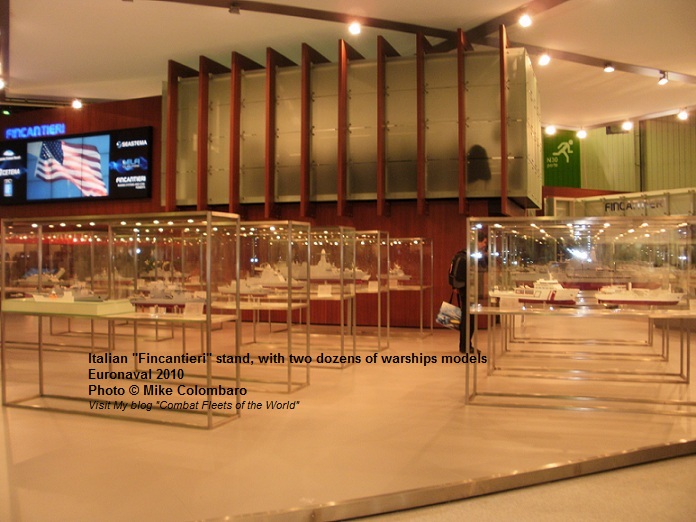
Fincantieri Stand during Euronaval 2010.


Another view (aft) from the Spanish "F2M2" advanced frigate, Navantia


A aft view from the Singapourian "Endurance 160" LHD design, ST-Marines


Singapourian armed OPV design, ST-Marines


Russian "Project 22500" corvette design


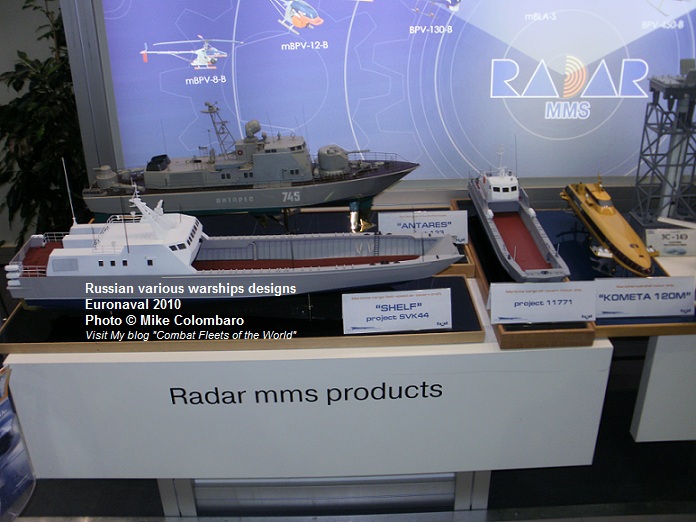
Russian's landing crafts & others designs


German "Type 125" frigate


Warships news to come back on Monday 01/11 !

Oct 29, 2010

Pictures from EURONAVAL 2010 (Part 3)

Last round of views


French SSBN
& SSN designs, DCNS


Patrol Boats Family, CMN


German Newer 105 meters corvettes, LURSSEN


Australian ANZAC FFG frigate with newer integrated mast


British Fleet Replenishment Tanker design, Rolls-Royce


Colombian advanced Riverine patrols crafts


A aft view from current French carrier study, DCNS


Likely to share progressively others stuffs in some "warships forums" during discussions feeds ;)

Oct 28, 2010

Pictures from EURONAVAL 2010 (Part 2)


French "SMX-25" highly advanced mid sub/corvette demonstrator, DCNS.


Stealthy Italian small corvette "Falaj 2", for Middle East.


French "Gowind" Corvette/OPV family, DCNS.


A another view of the current French Carrier study.


Russian "Project 22 356" frigate design


Lot of warships using Thalès electronics technology.


French "BPC's & "Brave" designs, DCNS.

Oct 27, 2010

Pictures from EURONAVAL 2010


Me during Euronaval 2010 ;)


French advanced "advansea" frigate designs, DCNS


French study for PA02 (conventionnal props), DCNS


Advanced Spanish "F2M2" frigate design, Navantia


French "MPC" modular warships, CNIM


Future Italian 20 000 tons LHD.


Singapourian "Endurance-160" LHD design, ST-Marines

Oct 8, 2010

Future of the Israeli Navy

or live beyond their financial means ...

Cartography
Coastlines:

273 km (170 mi), + a part of the Sea of Galilée lake (166 square kilometers (64 sq mi)) + a part of the Dead Sea (810 km2 (310 sq mi))

Personnal Strenght (max): 11 800+

Regular sailors: +/- 5500; Conscript: +/- 2500; Naval Commandos: +/- 300; Coast Guards : +/- 50 ; Reserve/Mobilisation: +/- 3500.

3 Corvettes (up to 5 by 2016)

Up to 2 german corvettes
The Israeli Navy were currently under final negociation with Germany for the purchase of 2 newer missiles corvettes, maybe for a 1st deliverie around 2015 ?. The 2 main possible designs were:
- a improved MEKO A-200 (with a mini Aegis)
- or the more advanced MEKO CSL ?
(in any case, the final design retained will be probably carried a small AAW weapons systems, likely a Israeli indigenous radar).

3 Eilat class (Sa’ar 5)

(Eilat, Lahav, Hanit). 1200 tons, 85 meters. Highly advanced warships for their times (early 1990’s), but suffered from serious topweight problems. Commissioned by 1994/1995, with probable 30+ year service life expected, to be retired by late 2020’s.

10 Fast Missiles attack crafts (something new from something old)

8 Hetz (sa’ar 4,5)
The 2 first ships (Romach, Keshet) commissioned by 1981/1982, a third ship (Hetz) commissioned by 1991, a another group of 3 ships (Kidon, Tarshish, Taffo) delivered by 1994/1998 and a last group of 2 ships (Herev, Sufa) commissioned by 2002/2003. +/- 480 tons, 61 meters very effective ships, but some of these ships suffered from topweight problems. To be progressively retired through mid 2010’s/mid 2030’s.

2 Reshef (Sa’ar 4)
(Nitzachon, Atzmaut). 450 tons, 58 meters. Commissioned by 1978/1979, now ageing unit, likely to be retired trough 2010’s.

In fact, it become clear that all these medium fast missiles attack crafts were well designed for coastal ops again "medium-end" threats (small/medium "arabs navy"...).

+/- 30 Mid shore Patrol boats (THE REAL WORKHORSE OF THE ISRAELI FLEET !!!)
+/- 15 Dabur class
40+ tons, 19+ meters. 34 originally built by 1973/1977, now around 15 active. Likely to be retired through 2010’s. and replaced by the newer Shaldag/Dvora Mk III serie’s.

Up to 12 Super Dvora Mk III class

12 Ordered, under deliveries.

4 Super Dvora Mk II class
60 tons, 25 meters, Commissioned by 1996. To be retired trough 2020’s.

+/- 9 Dvora Mk I class
45 tons, 21 meters, 9 originally built by 1988, now 9 active. To be retired by early 2020’s.

5 Shaldag Mk II class
24+ meters, 5 ordered.

2 Nashshol class
(Stingray Interceptor 2000 design), 3 originally built by 1997/1998, 2 still active.

4 Tzir’
Uncertain data.

In fact, it become clear that all these small crafts were well designed for coastal ops again "low-end" threats (terrorist & so).

Inshore Patrol boats
Likely some RHIB for special forces, ect…

Up to 5 Submarines
3 Dolphin class
(Dolphin, Livyathan, Tekumah). German design (derived from type 212). Well know to be each able to carry 3 or 4 nuclear capable cruise-missiles. Commissioned by 1999/2000. With probable +/- 30 year of service, to be retired by late 2020’s.

2 Improved Dolphin
(not yet named). Currently under construction in german shipyards, to be commissioned around late 2010/early 2012.

Up to 4 furthers SSK ?
Currently, Germany has reconsidered providing funding for a sixth submarine for the Israeli navy. (due to the financial situation). Few israeli officials have repeatedly announced that the Israeli Navy had a future requirement of up to 9 submarines !. But this figure (probably announced to impress Iran…) seems too large & unrealistic for the Israeli finance (and real ops needs).

Unmanned crafts
Rafael Protector USV
The Israeli is well known to be one of the first navy of the world to operate USV craft.

2 Amphibious
1 Ashdod (LCT)
1 LCM (US type)

Auxiliary Ships
3 Cargo ships
(Keshet, Nir, Nahariya). Two of these has ex german type T45 auxiliary ships.

1 Tug
a 78 tons tugs.

Israeli Coast Guards (+/- 50)

4 Small patrol crafts

Naval Aviation
+/- 2 Aircrafts: 2 C-130
+/- 26 Helico:
(ASW use): 7 AS-565SA Panther, 2 SA-366 G Dauphin.
(SAR use): 17 Bel 212.

In resume:
The Israeli navy, to counter the Hezbollah/Syrian/Iranian threats, is trying to master at all costs the high seas (submarines, AAW corvettes). But it is very clear that these very expensive vessels can be paid ONLY by the financial US/German aid…. The REAL solution (and future) depends very probably from naval intelligence/cyber-wars (as usual) and smaller units.

Next fleet review/edito :
Future of the Mexican Navy or (if news events…) Future of the Royal Navy (chapter 2: THE DAY AFTER).

PS: I'm working on a mega/giga review of the Russian fleet, but this review (likely in 2 very big parts) is currently on standby (it can happen this November?).

As usual, It may be that in my opinion, I forgot programs ? (or made few mistakes ?, especially in smaller crafts !), then said it ! Feel free to comment and give your opinion !

Oct 1, 2010

Future of the Portuguese Navy

Think Atlantic, but don't forget the capability to sail much away...

Cartography
Coastlines:
943 km (586 mi) in continental Portugal, 667 km in the Azores, 250 km in Madeira and in the Salvage Islands.
Portugal has the 3rd largest EEZ
of the EU and the 11th in the world. The seazone over which the Portuguese have special rights over the exploration and use of marine resources, has 1,727,408 sqm.

Total Personnal Strenght (2006/2007 estimates):
Regular: 8775; Active reservists: 335; Reserve: 900: Portugese Marines: 1725.

Up to 1 LPD or Ro-Ro ?
Since some years, the Portuguese navy planned to acquire a sealift/amphibious ship able for “projection” use. Currently the current financial situation slow the project. The possible design contenders are:
- New Zealand 9000 tons “Canterburry” design.
- A smaller version of the Spanish Juan Carlos I design.
- A German MD 150 design.
- A smaller (12/14000 tons) version of the French “Mistral” BPC.
- A smaller dutch “Enforcer” LPD design.

It is possible that this ship appear around late 2010’s/through 2020’s.

5 Frigates (toward a common class by late 2020’s ?)
3 Vasco Da Gama
(Vasco da Gama, Alvares Cabral, Corte-Real), 3000+ tons, 115 meters (German Meko 200 PN design). Commissioned by 1990/1992, with probable +/- 30 year service life expected, to be retired by 2020/2022+.

2 Bartolomeu Dias
(Bartolomeu Dias, Francisco de Almeida), 3000 tons, 122 meters (ex dutch frigate of the « Karel Doorman » class). Designed by mid 1980’s. Originally in dutch service by 1994, transferred to Portuguese by 2009/2010. With probable +/- 30 year service life expected, to be retired by late 2020’s.

It is very likely that these 5 frigates, to be retired by late 2020’s, should be replaced by a single (as usual….fewer & bigger…) frigates class (three or four 3500/4500 tons frigates).

7 Corvettes (toward fewer and biggers…OPV)
3 Baptista de Andrade
(Baptista de Andrade, Joao Roby, Afonso Cerqueira), 1300+ tons, 81 meters corvettes (improved Joao Coutinho design). Built in Spanish shipyards. Commissioned by 1974/1975, with probable 30 year service life expected, to be retired by mid 2010’s.

4 Joao Coutinho
(Antonio Enes, Joao Coutinho, Jacinto Candido, General Pereira D’Eca), 1300 tons, 81 meters corvette design. Built in Spanish/german shipyards. Commissioned by 1970/1971, with probable +/- 30 year service life expected, to be retired soon, by early 2010’s.

These nearly similar 2 class of 1300 tons corvettes are planned to be replaced by a common class of OPV :

Up to 6 Viana do Castelo class OPV
(Viana do Castelo, Figueira da Foz, Sines, Ponta Delgada, Funchel, Aveiro). 1600 tons, 83 meters OPV (NPO 2000 Project). Commissioned by 2010/2012.

Up to 2 submarines (a total renewal !)
2 Tridente class
(Tridente, Arpao), 1700 tons, 65 meters SSK of the german type 214/209PN design. These 2 ships replace now 2 retired obsolete 1960’s SSK of French design. Commissioned by 2010/2011. With probable 30 year service life, to be retired around 2040.

4 Offshore Patrols Boats (toward 0 ?)
4 Cacine
(Save, Cacine, Zaire, Cuanza). 292 tons, 44 meters. Commissioned by 1970. Likely to be “indirectly” replaced by the newer “Viana do Castelo” OPV class.

Mid Shore Patrols Boats
4 Centauro
(Sagitario, Pegaso, Centauro, Orion). 94 tons, 27 meters. Commissioned by 2001 and to be retired by late 2020's/early 2030's.

1 Rio Minho.
“Rio-Minho”. 70 tons, 22 meters. Commissioned by 1991 and to be retired by late 2010's/early 2020's.

5 Argos
(Dragoa, Escorpiao, Cassiopeia, Hidra, Argos). 94 tons, 27 meters. Commissioned by 1991
and to be retired by late 2010's/early 2020's.

2 Albatros
(Cisne, Aguia). 43 tons, 21 meters. Commissioned by 1975/1976 and to be retired by late 2010's max.

Up to 5 LFC
(coastal Patrol Crafts), expected through 2010's ?

3 Training/Sailing ships
1 « Creoula »
1000 tons, 67 meters. 1937.

1 « Sagres »
1900 tons, 70 meters, 1937

1 « Polar »
70 tons, 23 meters, built by 1977 in dutch shipyard and transferred to Portuguese by 1983.

1 Fleet Tanker
1 « Berrio »
4700/11500 tons, 140 meters. Ex british “blue rover”, built by 1970, transferred by 1993. To be retired by late 2010’s/early 2020’s and ? maybe ? replaced by a more versatile ships (maybe a smaller Joint Support Ship design ?)

Others Auxiliary
up to 2 future "pollution combat ships (NCP's)
Derived from the NPO 2000 OPV design. To be commissioned during 2010's.

1 « Shultz Xavier »
900 tons, 56 meters,
Buoy ship, 1972.

2 « Andromeda »
(Auriga, Andromeda), 245 tons, 31 meters.
Hydrographic ships, commissioned by 1988.

Small amphibious crafts
1 LCT
1 « Bacamarte » 650 tons, 56 meters, 1985.

1 LCU (maybe confused with the LCT ?)

Some LARC-5 amphibious vehicles.

Some Zebro class inflatable boat.

Some LDM 100/400 landing crafts

Portuguese Marines (1725 troops)
15 heavy mortars (120mm).
Some others mortars (60/81mm).
Some anti-tank missile/recoilless guns.
20 Pandur II (8x8) Heavy Armored Vehicles under delivery. Obviously, some others lighters vehicles & so.

Portugese Naval Aviation
5 helico:
5 Lynx Mk95 (super lynx)


The Portuguese Navy was currently under heavy modernisation (sub's, patrol crafts). Although the country's financial ressources are tighter, the Portuguese Navy may be happy to have a +/- reasonnable size (except in naval aviation), consistent with the portuguese ambitions.

Next fleet review/editorial: Future of the Israeli Navy.

As usual, It may be that in my opinion, I forgot programs ? (or made few mistakes ?), then said it ! Feel free to comment and give your opinion !

Sep 17, 2010

Future of the New-Zealand Navy

Only able to conduct small peacekeeping ops in the Pacific/Indian Ocean’s (frigates excepted), but asked thee more ?

Cartography
Coastlines: 15 134 km (9 398 mi).
The country claims the seventh-largest EEZ in the world, covering over four million square kilometres (1.5 million sq mi), more than 15 times its land area.

Personnal strength
(January 2010): +/- 2900 (+ 2500 volunteer)
Regular: 2162; Naval-Reserve: 338; Civilian: 400; Coast-Guard: +/- 2500 volunteer.

1 Sealift Ro-Ro ship
1 Canterburry
“Canterburry”, 9000 tons Ro-Ro (derived from the commercial Ro-Ro "Ben-My-Chree" design). Commissioned by 2007, with probable 25+ year service life expected, to be retired during 2030's. The ship experienced initially some troubles (& even more worse, some initial specification not reached).

2 Small Landing Crats
2 LCM
50/100 tons, 23 meters.

2 Frigates
2 Anzac
“Te Kaha, Te Mana”. 3600 tons multi-purpose frigates from the Anzac program. Commissioned by 1997/1999, with probable +/- 30 year service life, to be retired by 2027/2029.

These 2 vessels will most likely be replaced by 2 future frigates of the same design of future Australian frigates (it intended to replace the Anzac’s, by late 2010’s/late 2020’s). It is very likely that the New Zealand Navy, with limited financial capability, will participate in the Australian project, to reduce the cost of acquisitions.

1 Fleet Tanker
1 Endeavour
“Endeavour”, 7000/12 000 tons, commissioned by 1988. With probable 30 year service life, to be retired by late 2010’s/early 2020.

2 Ocean Patrol Vessels
2 Otago
“Otago, Wellington”, 1900 tons, 85 meters. Commissioned by 2008/2009. Considerable troubles experienced (overweight problems, initial requirement not fully reached). With probable +/- 25 year service life expected, to be retired by 2033.

4 Mid Shore Patrol Vessels
4 Rotoiti
“Rotoiti, Hawea, Pukaki, Taupo”, 340 tons, 55 meters. Commissioned by 2009, with probable +/- 20/25 year service life expected, to be retired by 2030/2033.

1 ocean survey vessel
1 Resolution
“Resolution”, 2200 tons, 68 meters (ex US Stalwart class ships built in the 1980’s, transferred by 1997). Likely to be replaced late 2010's/early 2020's by a civilian loaned (or built) ship ?

1 Diving support ship
1 Manawanui
“Manawanui”, 900 tons, 43 meters. Commissioned by 1988, likely to be retired by late 2010's/early 2020's.

Naval aviation
5 helico
5 Kaman SH-2G Seasprite. (newly built seaframe), Delivered by 2001/2003.

Royal New Zealand Coast Guard (civilian volunteer, SAR use)
+/- 75 various small crafts
(9,5 meters RHIB, few small rescue crafts)

2 helico or aircrafts?

In the recent years, the Royal New Zealand Navy has modernized considerably its surface fleet (newer Sealift/Patrol ships). But the country’s limited resources ($, population), coupled with a “specific” New Zealand policy/strategy, require the Navy to have a naturally reduced format. But this small size is probably a bit too small, because the country has vast areas of ocean in the south Pacific (the seventh largest Exclusive Economic Zone of the world, with 4 million square kilometers). 2 furthers Ocean Patrol Vessel, 3 furthers Mid-Shore Patrol Vessels, few long range UAV and few additionnal SAR helico……would not be too.

Next fleet review/editorial: Future of the Portuguese Navy.


As usual, It may be that in my opinion, I forgot programs ? (or made few mistakes ?), then said it ! Feel free to comment and give your opinion !

Sep 10, 2010

Future of the Iranian Navy

Any realistic hope in conventional high-sea naval warfare (due to US/Israeli supremacy), but coastal/asymmetrical naval warfare remain the only “serious chance”.

Cartography:
Coastline:
2440 kilometers (1520 mi) in the Gulf + 740 kilometers (460 mi) in the Caspian Sea.

Personnal strength (+/- 53 000):
Regular/Conscript sailors: +/- 28 000; Islamic revolutionary guard corps naval force: +/- 20 000 (including 5000 “marines”); Iranian navy « marines » corps: 2600; Iranian naval aviation: 2600.

+/- 7 Corvettes:
3 Alvand class
“Alvand”, “Alborz”, “Sabalan”, 1540 tons, 94 meters british Vosper Mk5 corvette design of late 1960’s. Commissioned by 1971/1972. Now totally obsolete. Likely to reach the end of these useful life by late 2010’s and +/- replaced by the later “Moudge” class corvettes.

2 Moudge class
“Jamaran”, “Velayat”, 1400 tons. Slightly improved Alvand design with some Iranian indigenous systems. Commissioned by 2010/2012, with probable 30+ year service life, to be retired by late 2040’s. Likely 2 or 3 further ships planned through mid/late 2010’s to replace ageing “Alvand” class.

2 Bayandor class
“Bayandor, Admiral Naghdi”, ex US patrol corvettes PF 103 design (1100 tons, 83 meters), built by 1964. Armed with 4 SSM missiles and guns, now totally obsolete. Likely to reach the end of their useful hull-life by 2010’s and maybe indirectly replaced by newer “Moudge” class corvette or their life will be desperately extended in event of higher tension with US/Israel…

Likely a newer Iranian corvette design (much improved “Moudge”) is under study, and maybe (if any major war erupt with US/Israeli during 2010’s…) 2 or 3 newer ships were expected by late 2010’s/early 2020’s.

+/- 5 Mid-Shore Patrol boats:
3 Parvin class
(Parvin, Bahram, Nahid), 98 tons, 30 meters (ex US PGM-71 design, delivered during 1970’s), gun armed. Likely to reach the end of their useful life by late 2010’s.

2 (or 3 ?) Kaivan class
(Azadi, Mehran, maybe a third boat in unserviceable condition?), 98 tons, 28 meters, gun armed.

24 Fast Missiles Attack Crafts:
10 “Houdong/Thondar” class
(Fath, Nasr, Saf, Ra’ad, Fajr, Shams, Me’raj, Falaq, Hadid, Qadir). 38 meters 170/200 tons Chinese built FAC with 2 SSM missiles & MG, commissioned by 1994/1996, to be retired by late 2030’s.

10 Kaman class
(Kaman, Xoubin, Khadang, Falakhon, Shamshir, Gorz, Gardouneh, Khanjar, Neyzeh, Tabarzin). 275 tons, 47 meters French built “Combatant” FAC family, with 4 SSM missiles & guns. Commissioned by 1977/1981, expected to reach the end of their useful life by late 2010’s.

4 Paykan class
(Paykan, Joshan, Derafsh, Kalat),
Indigenously Iranian built & improved version of the Kaman class, 275 tons, 47 meters, with 4 SSM missiles & guns. Commissioned by 2003/2008. To be retired by 2040’s.

Likely some further ships (4 to 12 ?) were planned through 2010’s (Improved “Paykan” or a newer design ?) to replace +/- progressively the ageing “Kaman” class.

+/- 60 Small Fast Missiles Attack Crafts/Torpedoes Crafts:
9 Chinese cat-14
14 or 23? meters, 20 tons Chinese built design, now built under licence by Iran, with 4 SSM missiles & MG. The 5 first ships were delivered by Chinese in 2000, the next 4 were Iranian built ships by 2003-2008. Maybe few others under constructions ?.

Up to 25 Peykaap II class
13 tons, 17 meters, North-Korean built (IPS-16, FAC version), with 2 torpedoes & MG. Real number likely between 10 to 25 ships. Maybe few others under construction ?

10 Tir class (IPS-18)
28 tons, 21 meters, with 2 torpedoes & MG. 10 Mk-13 14 meters Chinese design, delivered by 2006, with torpedoes or SSM missiles.

3 Kajami class
20 meters (North-Korean Taedong B design), delivered by 2002, able to carry 2 torpedoes.

3 Gahjae class
15 meters (North-Korean Taedong C design), delivered by 2002, able to carry 2 torpedoes.

92 ??? Bavar class
(Iranian built). Uncertain data
, very unlikely

Likely some (+/- 2 or 3 dozens?) furthers boats (China or North Korean or Iranian designs) were planned through 2010’s to enhance/modernize the Iranian navy coastal defence capabilities.

+/- 110 Small Fast attack Crafts/Patrol-Crafts:
15 Peykaap I class
13 tons, 17 meters, North-Korean built (IPS-16, patrol crafts version), with MG. Maybe few others under construction ?

3 Zafar class
70/82 tons, 85 foot North Korean “Chaho” design, armed with rockets & MG.

6 MIG-S-2600 class
70/80 tons, 85 foot Iranian built, derived from North Korean “Chaho” class, armed with rockets & MG.

10 Pasche class
(MIG-S-1900 design).

20 MIG-S-1800
22 tons, 51 foot Iranian built, derived from US PCI class delivered in the 1970’s. Armed with MG.

6 Mk-II:
22 tons, 50 foot, armed wiyh MG (26 originally delivered by US in 1976/1977).

9 or 10 Mk-III:
28/41 tons, 19 meters, armed with MG (20 originally delivered by US in 1975/1976).

3 Sewart class
10 tons, 40 foot US built (12 originally delivered by US through 1970’s), armed with MG.

+/- 30 Boghammer class (MIG-G-0900)
6+ tons, +/- 9 meters, armed with MG & small rockets. (51 originally delivered bu Sweden by 1984/1985).

Very likely some of these western 1970’s/1980’s built small crafts (Mk II-III/Sewart/Boghammer) were unserviceable/worn-out/in bad-shape due to age/lack-of-spare.

6 Wellington patrol crafts
(2 Mk 4; 4 Mk 5)

1 Iran
A indegenous iranian built small craft ?

+/- 77 Others various small crafts:
3 MIL
(2 MIL 40; 1 MIL 55)

6 GHAEM
(MIG-S-1800 design)

20 MURCE
(MIG-S-0900 design)

15 TARLAN

10 KASHDOM II

20 ASHOORA I
(MIG-S-0800 design)

2 KARBALA
(MIG-S-3700 design)

1 LIYAN 110

+/- 200 miscellaneous small crafts :
+/- 200 (RHIB, small fast “militarized” racing-boats, small-harbor crafts…).

Some of these crafts, although with a very limited autonomy/seakeeping, were able to be used as decoy/suicide crafts.

Nota: Since the late 1990’s, the Iranian Navy has worked to enhance its small patrol boat inventory by purchasing few fast boats (racing-boats, 50+ knots) from foreign speedboat manufacturer (Italian “Fabio-Buzzi (FB)” or British ”Bradstone-Challenger” designs…). Apparently the Iranian Navy “reverse engineered” the boats and began indigenously producing them (likely for Intelligence/Suicide/Harassing ops use).

Unmanned Crafts:
The Iranian Navy also reportedly is working on incorporating small "unmanned vessels" into its inventory, for intelligence/suicide ops.

3 Submarines:
3 Kilo class
4000 tons SSK (Russian Kilo SSK design). “Tareq, Noor, Yunes”, commissioned by 1992/1997. Likely with +/- 30 year service life, to be retired by 2025 and maybe replaced by a indigenous +/- 1000/1500 tons coastal SSK. Likely to be a “main-priorities” target for the US/Israeli forces in event of war.

Up to 13+ Midget Submarines:
1 Qaaem class
“Qaaem”, 1000 tons, under construction.

1 Nahang Class
“Nahang”, 350/400 tons, commissioned by 2006.

Up to 7 Ghadir class
“Ghadir”, others not officially named, 120/150 tons, commissioned from 2007-...

4 Yugo (Yono IS-120 ?) class
25 tons, midget submarine built by North-Korean.

8 ? (likely much more) Swimmer Delivery Vehicle
“Al Sabehar" class ?
8 meters ?...Any serious data found on the open web source (except propaganda pictures...). But it is very clear that Iranian frogmen’s were extremely well trained for special ops (attack on ship at anchor/harbor…).

Very likely the Iranian small sub’s fleet is expected to growth considerably in size during 2010’s because the cost/effectiveness of Midget (25/250+ tons) or coastal (400/800 tons) sub’s in restricted/Shallow waters (aka. Gulf-waters) was considerable (more cheaper/effective/stealthy than bigger 1500+ tons subs designs), and this, despite a smaller autonomy/sea-keeping quality (not very important in restricted/shallow waters).

2 Mine Warfare:
2 Riazi class
(Harischi, Riazi), 98 tons, 29 meters minesweeper (ex US Cape class).
A great shortcoming for the Iranian Navy.

Amphibious:
4 Hengam LST
(Hengam, Larak, Lavan, Tonb), 2500 tons, 93 meters LST, british design derived from Sir Lancelot class. Commissioned by 1984/1985. Likely to reach the end of their useful life by late 2020’s.

3 Iran Hormuz 24
2000 tons, 240 foot, South-Korean built, 1985/1986. Likely to reach the end of their useful life by late 2020’s.

2 (3?) Iran Hormuz 21
1400 tons, 213 foot, Dutch-built, 1984/1985. A third ship unserviceable. Likely to reach the end of their useful life by late 2020’s.

3 “Fouque” class
250 tons, 125 foot Landing Ship Large (LSL), Iranian built 1988/late 1990’s.

6 LCT/LCU “Rotork” class (type 412)
9 tons, 42 foot, British built (originally 14 delivered).

With a ageing amphibious fleet (mainly from 1980’s). It is very clear that the Iranian navy will need to begin newer amphibious ships acquisitions projects by mid/late 2010’s for a first commission by early/mid 2020’s.

Few Hovercrafts:
Few SR N6 hovercraft
10 tons, 17 meters British design, delivered by 1973/1975.

Few BH 7 logistic support hovercrafts
18/56 tons, 24 meters British design. Originally 6 BH 7 (two BH 7 Mk4 & four BH 7 Mk 5A) were delivered to the Iranian navy by mid 1970’s.

But now, with embargoes/ageing-systems/lack-of-spare, nearly the entire Iranian hovercraft fleet (British built) was reduced to a embryonic/anorexic size (some crafts were deliberately cannibalized to provide spare-part for others in better condition, others were in storage, with probable any future hope to see the sea…).

3 Auxiliary ships:
1 Kharg class replenishment ship
“Kharg”, 33 000 tons, 207 meters British design (derived from Olwen design), commissioned by 1984, likely to reach the end of their useful life by mid 2020’s.

2 “Bandar-Abbas” class light replenishment ship
(Bandar Abbas, Booshehr), 4600 tons, 108 meters German built design, commissioned by 1973/1974, likely to reach the end of their useful life by late 2010’s.

With these 3 ageing ships, the Iranian navy need to acquire 2 or 3 newer ships by late 2010’s/early 2010’s.

+/- 24 Multi-purpose tenders:
7 Delvar class water tanker
(Delvar, Charak, Chiroo, Souru, Silim, Sirjan, Dayer), 1300 tons, 63 meters Pakistani built. Commissioned by 1978/1982. Likely to reach the end of their useful life by 2020’s. Can be used as cargo ship/water tanker/minelayers/mothers ships for midget submarines/small crafts.

13 Hendijan class general purpose tenders (MIG-S-4700 design)
(Hendijan, Konarak, Sirik, Geno, Kalat, Genaveh, Savatar, Mogam, Rostani, MMayband, Maqam, Khoramshahr, Bamregan).

4 Kangan class water tanker
(Kangan, Teheri, Marjani, Amir), 12 000 tons (Indian design built), commissioned by 1979. Can be used as a patrol boat.

Some of these ageing (late 1970’s) tenders were +/- in bad shape, few with reduced readiness. Likely some others civilian’s ships were able to be converted as mothers/intelligence ships in a even of war.

Few hundreds of Civilian built crafts:
Several dozen of civilians/privates “Dhow” & “trawlers”, able to be used as mothers ships/Intelligence ships.

Several dozen (or few hundred ?) of civilians/privates owned RHIB/small-crafts, able to be “militarized” as suicide/intelligence/decoy crafts.

Coastal battery/artillery:
Artillery
(likely “shared” between the two “marines corps” & the land army): Without doubt, some 105/122/152mm guns (towed or self-propelled) were used in coastal artillery + some anti-tank missiles or recoilless rifles (75/82/106/107mm) and even mortars (60/81/82/107/120mm).

Airborne anti-ships missiles (shared with Iranian air force):
AS-10 Karen/AS-11 Kilter/C-801K/C-802 and maybe others.

Coastal anti-ships missiles (estimations):
100 + C-802/802A “Noor”.
100 + HY-2 “Silkworm”.
Some C-701T/C-201R/TL-10 A/B “Kosar various versions”.
Some Ra’ad.

Obviously, don’t forget the Iranian naval-mines arsenal, able to disrupt the oil world traffic through the Ormuz strait for several weeks or more likely few months…

Iranian Naval Aviation (estimations):
+/- 55 Helico:
4 Aero Commander ; 4 Shrike Commander ; 2 Bell AB 205; 20 Bell AB 206A; 15 Sea-King SH-3D; 10 Sea-Stallion RH-53D.

+/- 9 Aircrafts:
2 Falcon 20 ; 4 Fokker F27 ; 3 PF-3 Orion.

Some aircrafts from the Iranian air force (F-4D Phantom, Su-24 Fnecer, Mirage F-1) have a anti-ship capability.

In any case, some US/Western built helico/aircraft were in storage or in reduced service, mainly due to embargoes/ageing/spare-part/maintenance problems. Some helico/aircrafts were “cannibalized” for provide urgent spare part for much fewer helico/aircrafts in better condition.

In resume:
In event of a war with US/Israeli force, the biggest Iranian ships (Kilo subs, Corvettes, +/- medium auxiliary/landing ships (500+ tons), 100+ tons FAC) will be easily found & sunk in the first’s dozens of hours in a major war. The smallest units (under 50 tons), the coastal defence (Missiles battery/naval-mines) and the iranians specials forces (frogmens/commandos...) probably represent the main chance for the Iranian navy to effectively “withstand” the first main US/Israeli strike…

Next fleet review/editorial: Future of the Royal New Zealand Navy.

As usual, It may be that in my opinion, I forgot programs ? (or made few mistakes ?, especially in small-crafts), then said it ! Feel free to comment and give your opinion !

Sep 3, 2010

Future of the South Korean Navy

One of the seven largest navy of the world by 2022...

Personnal strenght (+/- 72 000):
+/- 68 000:
(including +/- 28 000 south-korean "marines", +/- 45 000 regular sailors and +/- 19 000 conscript).

+ 4500 (maritime police).

2 LPH/LHD (up to 4):
2 Dokdo Class
18 000 tons LPH, a modern LPH design (derived from dutch Thales Netherlands design studies). "Dokdo, Marado-Island", commissioned by 2007/2011. With probable +/- 30 year service life expected, to be retired by 2037/2041.

2 bigger & improved ships were planned by late 2010’s (likely a 30 000+ tons, full F-35 capable).

Others Amphibious ships:
4 Go Jun Bong class
"Go-Jun-Bong, Bi-Ro-Bong, Hyang-Ro-Bong, Sung-In-Bong), 2600/4300 tons LST style, commissioned by 1994/1998. With probable 35+ years service life expected, to be retired by late 2020’s decade. Likely one of these current ship will be “loaned” to the Royal Malaysian navy .

4 Alligator LST.

Very likely a new program of medium amphibious ships (+/- 3000/5000 tons) was underway, but sorry I not find data about it !

43 landing crafts (2006/2007 estimates + updates)
- 6 LCT, 20 LCVP, 10 LCM.
+ 3 LSF-I (project 12 061E Murena-E).
+ 4 LSF-II (Indigenous built US LCAC).


12 Destroyers/Frigates
3 Sejong the Great class (KDX-III)
"Sejong-the-Great, Yulgok-Yi-I, Kwon-Yul", 11 000 tons, enlarged design derived from US Arleigh Burke IIA flight, a very extremely powerfull AAW ship design, even more capable than the current US aegis CG/DDG ships !, commissioned by 2008/2011. With probable 35+ year service life expected, to be retired by 2043/2046.

Up to 6 "KDX-IIA" by 2022
A second batch of 3 KDX-III, originally planned toward 2018/2022 was finally cancelled because the future south Korean navy needs change rapidly, from very high-end warships (very powerful/ expensive) to a mid-end warships (+/- powerful but cheaper, more affordable in greater number). Consequently, the further three 11 000 tons KDX III was cancelled and replaced by 6 newer 5600 tons KDX IIA (improved KDX II with Aegis).

6 Chungmugong Yi Sun-Shin class (KDX-II)
"Chungmugong-Yi-Sun-Shin, Munmu-the-great, Dae-Joyeong, Wang-Geon, Kang-Gamchan, Choi -Young). 5000 tons. Commissioned by 2003/2008. With probable 30 year service life, to be retired by 2033/2038.

3 Gwanggaeto the Great class (KDX-I)
"Gwanggaeto-the-Great, Eulji-Mundeok, Yang-Manchun". 3800 tons. Commissioned by 1998/2000. With probable 30 year service life, to be retired by 2028/2030.

9 Light frigates (to be replaced by fewer/bigger ships):
9 "Ulsan"
"Ulsan, Seoul, Chungnam, Masan, Gyeongbuk, Jeonnam, Jeju, Busan, Cheongju", 2300 tons, commissioned by 1981/1993. With probable 30+ year service life, all to be retired by 2011/2023 and partially replaced by a newer series of six 5600 tons KDX-IIA frigate (improved KDX-II with Aegis system) by 2018/2022.

+/- 23 Corvettes:
22 Pohang class
1200 tons corvette, in 3 batch :
- 3 Batch 1 (SUW), "Gunsan, Gyeongju, Mokpo", commissioned by 1984/1986.
- 17 Batch 2 (ASW): "Gimcheon, Chungju, Jinu, Yeosu, Jinhae, Suncheon, Iri, Wonju, Andong, Bucheon, Seongnam, Jecheon, Daecheon, Sokcho, Yeongju, Namwon, Gwangmyeong", commissioned by 1987/1991.
- 2 Batch 3 (AAW) "Sinseong, Gongju", commissioned by 1992/1993.

1 Donghae class
"Anyang", 1000 tons, 1983. Likely to be retired soon (3 others similar ships recently decommissioned).

The FFX project (up to 24 ships ?):
These 22 “Pohang” corvettes and 1 “Dong Hae” corvette will be replaced by a newer class of frigate (the FFX project). As usual, this new class of frigate will be much bigger (3200 tons), better armed (a 76 or more likely a 127mm gun, a CIWS system, one helico with hangar) and build in massive number (12 to 24 ships).

The recent "Chenoan disaster" highlight the need for a stronger ASW suit for the future South Korean ships. It is clear that the South Korean Navy will try to integrate in these new vessels a stronger anti submarine capability. If unfortunately the CURRENT FFX design does not include a ASW VLS missiles (to carry Red Shark missile), because the first ship of this series is scheduled for 2012, it is very likely that the first "batch"of 6 vessels (to be commissioned by 2012-2015) will have the original design.
A very likely second "batch" (12 to 24 vessels ? between 2015/2022), probably benefit from greater improvements (superstructures modified, maybe slightly enlarged with a "pluggin" few hull meters added, to more easily insert VLS).

+/- 75 Fast attack missikes crafts (expected to fall in number & growth in size):
Gumdoksuri class
570 tons fast craft intended in 2 batch:
- 24 PKX-A (or Yun Youngha class), a missile patrol ship.
- 18 PKX-B, a patrol boat (Yoon Youngha, Han Sanggook, Jo Chunhyung, Hwang Dohyun, Suh Hoowon, Park Donghyuk, others future craft not yet named). Maybe others "batch" ? planned by late 2010's ?. Intended to replace the ageing "Chamsuri" FAC.

+/- 75 Chamsuri class
170 tons.

12 Submarines (toward a domestic capacity in 2020 ?)
3 (+6) Sohn-Won-Yil class
"Son Won Il, Jeong Ji, An Jung Geun", 1900 tons, type 214 SSK. Commissioned by 2007/2009.
6 others subs was ordered to be commissioned by 2014/2018.

9 Chang Bogo class
"Chang Bogo, Lee Chun, Choi Museon, Park Wi, Lee Jongmu, Jeong Un, Lee Sunsin, Na Daeyong, Lee Eokgi", 1800 tons, type 209 SSK. Commissioned by 1993/2001, with probable +/- 30 year service life expected, to be retired by 2023/2031.

SSK(X):
Likely +/- 3 newer 3000+ tons SSK (of a indigenous design) were expected by early 2020 with a 4th ship maybe to become the 1st south Korean SSN by mid 2020’s ?

+/- 11 Coastal submarines:
2 "Dolgorae" class.
9 "Dolphin" class.

+/- 10 Minewespeers:
1 "Wonsan" class minelayer ship.
3 "Yangyang" class Mine-hunter.
6 "Ganggyeong" class coastal mine-hunter.

+/- 10 Auxiliary's (estimation):
3 "Cheonji" class combat support ships.
1 "Cheonghaejin" class submarine rescue ship.
2 "Pyeongtaek" class salvage/rescue ships (ex us Edenton class).
1 "Sinsegi" class intelligence ship.
1 "Sincheonji" class AGS ship.
1 "Dadohae" class, midget submarine tender ship.

Naval Aviation (estimation):
19 Aircrafts: 16 P3C (8 P3C, 8 P3CK); 3 Cessna F406, 8 S-2E tracker (some in reserve).
38 Helico (+9): 10 UH-60P; 23 Lynx (11 Mk 99, 12 Mk 99A); 5 Alouette III + 9 Hughes 500 (South-Korea Maritime Police).

South Korea Maritime Police (2006/2007 +/- "inacurate" estimates):
1 PSO:
1 "Sumjinkang".

10 PCO:
1 "Han Kang".
3 "Mazinger".
6 "Sea Dragon".

33 PCC
(4 Burkhansan, 7 Hyundai type, 22 Sea Wolf/shark).

+/- 20 PCI
18 Seagull PBI
3 ARS

Several KCH 100 tons patrol boats.

65 KCG 50 tons patrol boats (commissioned by 2002/2006).

South-Korean Marines Corps (estimates):
+/- 28 000 troops.
60 M-47 tank.
+/- 100 AAV amphibious armored vehicles (42 AAV-7A1, 60 LVTP-7).
Some 105 & 155mm guns.

With a continuously growth, the South-Korean navy was expected to reach a considerable size by 2022:
- Two 30 000+ tons LPH.
- Two 18 000 tons LPH.
- 30 to 42 ! major surface combatant (3000+ tons) : Three 11 000 tons KDX-III, Six 5600 tons KDX-IIA, Six 5000 tons KDX-II, Three 3800 tons KDX-I, Twelve to Twenty-fourth 3200 tons FFX.
- Around 18 Submarines : 9 type 214, +/- 7/8 type 209, 1 or 2 SSK(X).

A considerable size helped by the economic/strategic/politic weight of some “Asiatic Giant/Tiger” country by 2020 (China, South-Korea, India, Indonesia, Singapour, Malaysia, Thailand) and by the continual decline of some “western” navy.

Next editorial: Future of the Iranian Navy
.

As usual, It may be that in my opinion, I forgot programms ? (or made few mistakes ?, especially in small crafts/auxiliary's/Coast Guards strenght), then said it ! Feel free to comment and give your opinion !